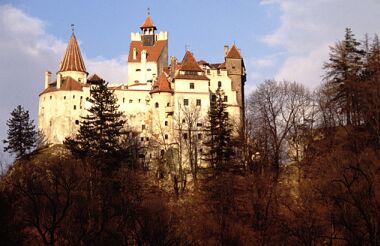
The Strategic Logic of the Bran Pass
The Bran Pass cuts through the Southern Carpathians at an elevation of roughly 1,290 metres, connecting the Transylvanian plateau to the lowlands of Wallachia to the south. Before the construction of reliable roads through lower passes, this corridor was among the few practical routes for wheeled traffic and mounted troops between the two territories.
Control of the pass meant the ability to levy tolls on merchants, regulate military movement, and deny or grant access between two political entities that were frequently at odds. The fortress at Bran was purpose-built to exercise that control from a defensible height.
Construction History
Teutonic Knights and the First Fortification (1211–1225)
The earliest fortification at Bran is associated with the Teutonic Knights, who were settled in the Burzenland region of Transylvania by King Andrew II of Hungary in 1211. Their brief tenure — ended by expulsion in 1225 — included the construction of a wooden watch post at the pass. No physical evidence of this structure survives, but its existence is recorded in the 1377 royal charter that authorised the Saxons of Brașov to build the stone castle.
The Saxon Construction (1377–1382)
In 1377, King Louis I of Hungary issued a charter granting the citizens of Brașov the right to build a stone fortress at the pass in exchange for their responsibility to defend and maintain it. Construction proceeded between approximately 1377 and 1382. The original plan comprised a rectangular keep on the summit of the limestone outcrop, a perimeter wall following the rock's contour, and a lower courtyard connected to the main structure by a covered stairway cut into the stone.
The builders worked within the practical constraints of the site: the narrow rock offered limited foundation area, forcing a vertical rather than horizontal expansion. The result was a compact tower house rather than a sprawling defensive complex.
15th-Century Enlargement
Between 1400 and 1460, the castle underwent its most significant expansion. A second tower was added to the northern end of the site, and the courtyard well — cut through 57 metres of limestone — was completed during this period. The covered staircase connecting the lower gate to the upper keep was rebuilt in stone. Janos Hunyadi, governor of Transylvania from 1441 and regent of Hungary from 1446, used Bran as a staging point during his campaigns against the Ottomans; written sources from his administration mention repair works to the defensive walls.
Wallachian and Ottoman Periods
From the late 15th century onward, Bran's status shifted. As the Ottoman threat to Wallachia intensified and the frontier moved southward, the pass lost some of its strategic primacy. The castle passed through the hands of several Transylvanian princes and, for a period in the 16th century, was held directly by the Wallachian voivodes who used it as a customs station rather than a military stronghold.
Romanian Royal Ownership and 20th-Century Modifications
After the unification of Romania in 1918, Bran Castle was gifted to Queen Marie of Romania by the citizens of Brașov in 1920. Marie undertook substantial modifications to make the medieval fortress liveable as a royal summer residence. The work, overseen in part by the Czech architect Karel Liman, included the addition of a tea house on the lower terrace, extensive replanting of the grounds, and the installation of electricity and running water. These interventions altered the interior spatial arrangement considerably, though the external silhouette of the towers was preserved.
After Marie's death in 1938, the castle passed to her daughter Princess Ileana, and was subsequently nationalised by the communist government in 1948. During the communist period it functioned first as a state-run museum and later as a storage facility, with minimal maintenance investment.
Restitution and Restoration (2006–Present)
In 2006, following a decade of legal proceedings, the Romanian government returned Bran Castle to the heirs of Princess Ileana, represented by Dominic von Habsburg. The restituted property included the castle, the lower park, and several outbuildings.
A restoration programme carried out between 2009 and 2013 addressed structural deficiencies in the northeastern tower, where water infiltration had compromised the lime-mortar joints between the 14th-century stone courses. Specialist conservators documented the original mortar composition through laboratory analysis and matched the repair material accordingly. The work was conducted with oversight from the Romanian National Heritage Institute.
The castle currently operates as a privately managed museum. Conservation work continues on a rolling basis, with priority given to the roof drainage system and the preservation of the late-medieval frescoes in the chapel.
Architectural Notes
Bran's floor plan is irregular, shaped primarily by the rock on which it stands. The main tower rises approximately 20 metres from its base; the masonry walls at the lower levels reach 2.5–3 metres in thickness. The internal staircase, cut partly through the living rock, remains in use. The courtyard well, at 57 metres, is among the deepest documented in a Romanian castle of this period.
The chapel, located in the northern tower, retains fragments of 15th-century fresco work, including a partial image of a donor figure that has not been definitively attributed to a specific patron.
Further Reading
- Radu Popa, Cetăți medievale din Țara Românească, Bucharest: Academia Română, 1988
- Romanian National Heritage Institute, patrimoniu.gov.ro — conservation dossier for Bran
- UNESCO World Heritage Centre, whc.unesco.org — Village with Fortified Churches in Transylvania
Last updated: May 1, 2026

