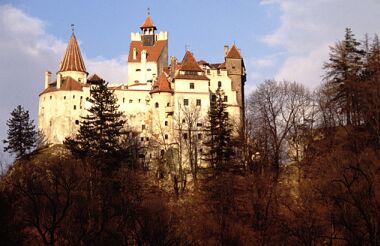
Origins and the Hunyadi Rebuilding
The site at Hunedoara has been fortified since at least the early 14th century. A royal keep appears in documentary sources from around 1315–1320, described as a possession of the Hungarian crown. The structure that dominates the site today, however, dates almost entirely from the tenure of John Hunyadi (Ioan de Hunedoara in Romanian), who received the castle as a gift from King Sigismund of Luxembourg in 1409 and undertook a comprehensive rebuilding programme that continued until his death in 1456.
Hunyadi's campaign of construction transformed a functional royal fortification into a statement of dynastic ambition. The programme proceeded in several identifiable phases, each adding volume and architectural elaboration to the original compact keep.
Phase I: The Knight's Hall and New Gate Tower (1440s)
The first phase of major expansion under Hunyadi produced the Knight's Hall (Sala Cavalerilor), a large vaulted chamber on the first floor of the main residential wing. The hall measures approximately 28 by 10 metres and is covered by a ribbed vault carried on slender octagonal pillars — a structural solution more commonly found in ecclesiastical architecture of the period. The stonemasons responsible for this work appear to have come from workshops active in southern Transylvania and possibly from contacts established during Hunyadi's military campaigns in Bohemia.
The gate tower was also rebuilt during this phase, incorporating a drawbridge mechanism with a counterweight system. The existing drawbridge, visible from the main approach, is a later reconstruction based on documented evidence of the original mechanism.
Phase II: The Diet Hall and Council Tower (1450s)
In the 1450s, as Hunyadi consolidated his position as regent of Hungary, a second building campaign extended the residential wing southward and added the Diet Hall — a larger ceremonial space above the Knight's Hall. The Council Tower (Turnul Neboisa) at the southwest corner was heightened during this period, reaching its current form. Its upper section carries distinctive decorative corbelling that has no direct parallel in other Transylvanian fortresses of the period.
Hunyadi died in 1456, shortly after the Siege of Belgrade, and is buried at the cathedral in Alba Iulia. His sons continued to hold the castle, and Matthias Corvinus, who became King of Hungary in 1458, made further additions including the loggia overlooking the inner courtyard.
Architecture: Form and Detail
The castle's current footprint is roughly trapezoidal, constrained by the rocky promontory above the Zlatiua River. The main residential block runs along the north and east sides of the courtyard; the defensive curtain wall, reinforced by five towers, encloses the western and southern perimeters. The total built area within the walls is approximately 7,000 square metres.
The exterior presents a varied skyline produced by towers of different height and profile built over several decades. The White Tower (Turnul Alb) and the Buzdugan Tower are among the most visually prominent; the former is a later addition from the late 15th century, the latter dates to the original Hunyadi construction phase.
The interior is notable for the quality of the Gothic stone carving in the window surrounds, doorways, and chimney pieces. Several capitals in the Knight's Hall carry figurative carving — animal heads, foliage, and one documented human face — of a quality suggesting workshop training in central European Gothic traditions rather than local craft production.
Ownership, Nationalisation, and Heritage Disputes
After the Hunyadi line died out, the castle passed through a succession of Transylvanian noble families. In the 17th century it came under Habsburg administration and underwent baroque modifications, including the addition of a new chapel wing. During the 19th century it was the subject of a major romanticising restoration campaign funded by the Kendeffy and later the Romanian state, which introduced elements — including some tower crowns and decorative battlements — that are not documented in pre-restoration sources.
Following nationalisation in 1948, the castle was managed by the Romanian state as a museum. Since 2011 it has been administered by the Hunedoara county council. The question of whether John Hunyadi should be classified primarily as a Romanian (Vlach) or Hungarian historical figure has made the castle a recurring subject of political friction between Romania and Hungary, though both governments have at various points acknowledged the shared cultural significance of the site.
Restoration Work
A systematic restoration programme was conducted in the 1960s and 1970s, addressing structural failures in the curtain wall and the roof structure of the main residential wing. Later work in the 1990s and 2000s focused on the drainage system and the stabilisation of the Knight's Hall vaulting, where differential settlement had produced cracks in two of the pillar bases.
A European Regional Development Fund project running from 2018 to 2023 funded conservation of the exterior stonework, replacement of the roof covering on the main block, and the installation of a visitor management system designed to reduce damage from foot traffic to the medieval floor surfaces.
The well in the inner courtyard — reputed in local tradition to have been dug by Ottoman prisoners, though this is not supported by documentary evidence — was also consolidated during this phase. The well reaches a depth of approximately 28 metres.
Further Reading
- Stefan Pascu, Voievodatul Transilvaniei, vol. II, Cluj-Napoca, 1979
- Adrian Rusu, Castelul de la Hunedoara, Cluj-Napoca: Accent, 2005
- Romanian National Heritage Institute, patrimoniu.gov.ro
Last updated: April 22, 2026